
Implant workflow
Implant Case Handoff: What the Lab Needs Before It Can Design
Implant cases fail at the connection, not the crown. This is the complete information a laboratory needs before it can design an implant restoration, and why each item matters.
Published October 3, 2026
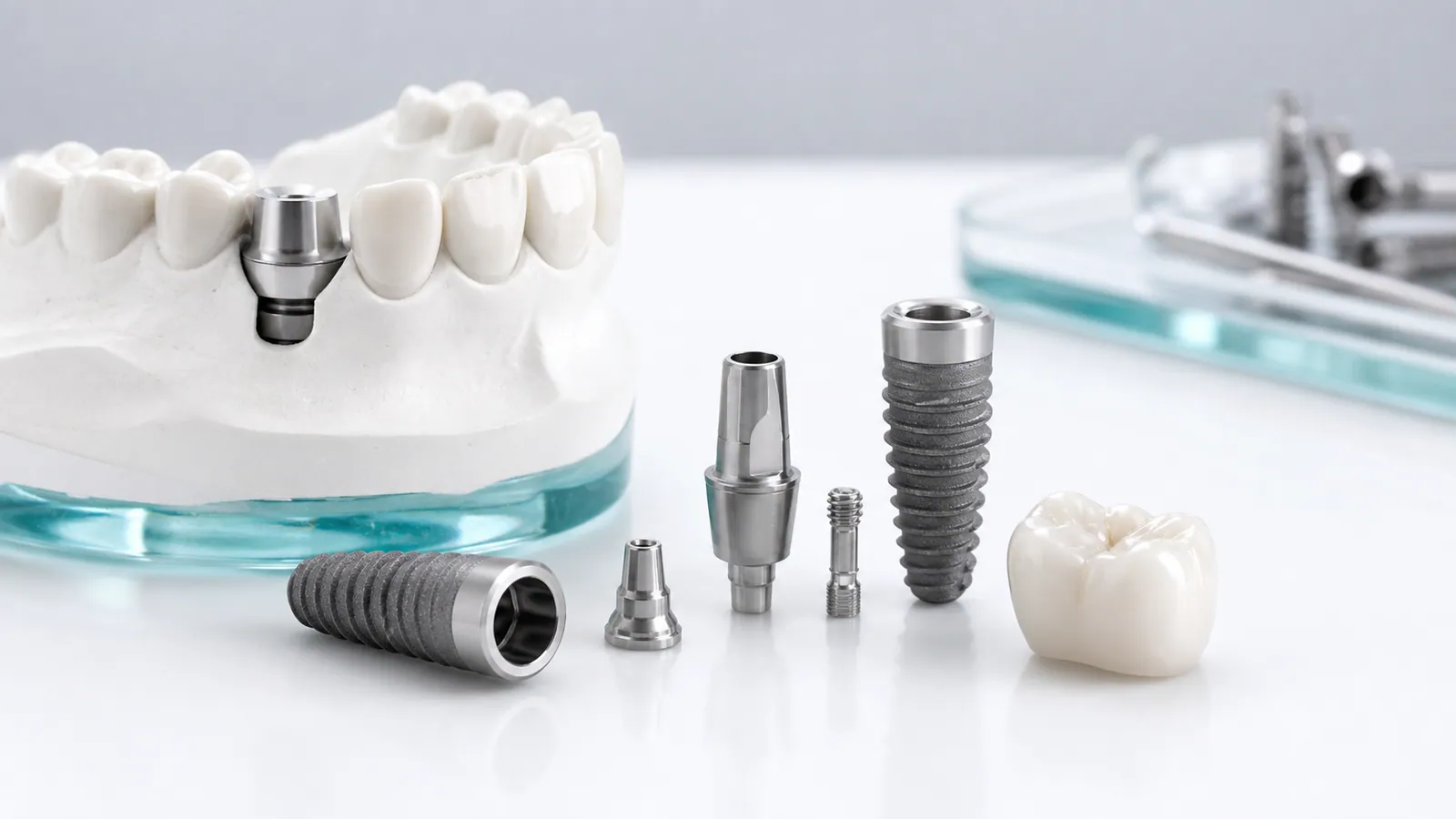
Implant restorations occupy a different category from tooth-borne work, because the restoration is only half the problem. The other half is the connection to the implant, and that connection is fixed by a manufacturing standard rather than by the design. Get the tooth-borne part wrong and the restoration is aesthetically or functionally off. Get the connection wrong and the restoration does not physically fit, or fits and fails.
This article sets out the information a laboratory needs before it can begin designing an implant restoration, and what the absence of each item actually costs.
Why implant cases need a different intake
For a tooth-borne crown, the preparation defines the interface. The laboratory reads the prepared surface and designs to it. For an implant restoration, the interface is defined by a component the laboratory did not create and cannot see in a scan alone: the implant fixture, its connection geometry and its position relative to the soft tissue.
Every downstream decision — abutment type, retention method, emergence profile, occlusal scheme — depends on those facts. So the intake is longer, and it is longer for a reason.
The information checklist
1. Implant system and connection
The manufacturer and system must be identified, and so must the connection type within that system, because a single manufacturer may produce multiple connections that are not interchangeable. This is the single most important item on the list.
The reason is mechanical. An abutment or restoration machined for one connection will not seat correctly on another, even where the two look similar. The failure mode is not a loose fit that can be adjusted; it is a mismatch of mating surfaces that can result in poor seating, screw loosening or component damage.
If the system is unknown, the options are to identify it from the records or the surgical report, or to have the connection identified clinically. Guessing is not an option, and a laboratory that guesses is taking a risk that properly belongs to the case.
2. Scan body or impression transfer data
For digital cases, the implant’s position in the arch is derived from the scan body. The scan body must be the correct one for the system, fully seated, and captured cleanly. Three specific problems matter:
- Wrong scan body. The position is derived incorrectly and everything downstream is wrong.
- Not fully seated. The scan body sits high or tilted, so the recorded position is offset.
- Poorly captured. Even a correctly seated scan body is useless if the scan did not record its geometry.
For conventional cases, the equivalent is the implant analogue and transfer, which must be correctly seated in the model.
3. Soft tissue and emergence profile
The restoration’s emergence from the implant to the tooth form is shaped by the soft tissue, and this is where implant aesthetics are won or lost. The information needed:
| Item | Why it is needed |
|---|---|
| Gingival height and thickness | Determines how much emergence can be shaped and how much can be sculpted |
| Location and depth of the implant platform | Sets where the restoration becomes visible |
| Whether an emergence profile was established | A healing abutment or provisional may already have shaped the tissue; this changes the design |
| Photographs of the site | Show tissue form in a way a scan records only as surface |
Where tissue form has been managed with a provisional or healing abutment, say so. Designing as though the tissue were undisturbed when it is not produces an emergence that does not match the sulcus.
4. Retention method
Whether the restoration is screw-retained or cement-retained is a design decision with clinical and geometric consequences, and it should be settled with the laboratory rather than discovered during design:
- Screw-retained requires a screw access channel, which constrains the position and angle of the access and therefore the occlusal design. Where the implant is steeply angled or placed palatally, the access may be unfavourable and this needs to be known early.
- Cement-retained requires more emergence space to allow a crown form over the abutment, and introduces a residual cement consideration.
The comparison is covered in more detail in screw-retained vs cement-retained implant crowns.
5. Occlusal scheme and loading
Implant restorations do not have a periodontal ligament, so they do not have the same proprioceptive feedback or the same capacity to absorb load. The occlusal design for an implant unit typically needs to be adjusted accordingly, and the laboratory needs to know:
- the patient’s occlusal habit, where a clenching or bruxing history is known;
- the intended occlusal contacts and whether a lighter contact is desired on the implant unit;
- whether the case is part of a multi-unit or full-arch reconstruction where the occlusal scheme is set globally.
6. Adjacent and opposing information
An implant crown does not exist alone. The laboratory needs the adjacent teeth and the opposing arch, for the same reason as any other case — contacts and occlusion are relationships, not properties of one unit.
What happens when an item is missing
A missing item does not usually mean the case is refused. It means it is held at intake until the question is resolved, which is a short exchange if the case is well documented and a long one if it is not.
| Missing item | What the laboratory does |
|---|---|
| Implant system | Asks; cannot proceed to design |
| Connection type | Asks; cannot select a component |
| Scan body data | Requests a rescan of the implant position |
| Soft tissue detail | Requests a photograph or a clinical description |
| Retention decision | Asks the clinician to confirm |
| Occlusal guidance | Asks before designing, rather than assuming |
This is the same gate described in how a dental lab reviews a scan before designing, applied to the implant-specific facts.
The planning point that prevents most of this
Most implant restoration problems start earlier than the restorative stage, at the planning and surgical stage, when the implant position is set. Position determines:
- the emergence profile and therefore the aesthetic outcome;
- the screw access angle and therefore whether screw retention is feasible;
- the occlusal load path and therefore the occlusal design;
- the soft tissue management required to achieve the intended result.
Involving the laboratory in the planning conversation — even briefly — moves these decisions upstream where they are free, instead of downstream where each one is a redesign. It is the same principle as checking occlusal clearance before scanning in the tooth reduction guide.
Related reading
- Common implant restoration errors — the failure modes in more detail.
- Custom abutment dental lab — when a custom abutment is the right answer.
- Screw-retained vs cement-retained implant crowns — the retention decision in full.
- All-on-X dental lab — the full-arch case, where these questions compound.