
Clinical preparation
Bite Records and the Articulator: Why Occlusion Goes Wrong
Occlusion problems are blamed on the lab more often than they originate there. This explains what a bite record actually conveys, how an articulator uses it, and where the record most often fails.
Published October 7, 2026
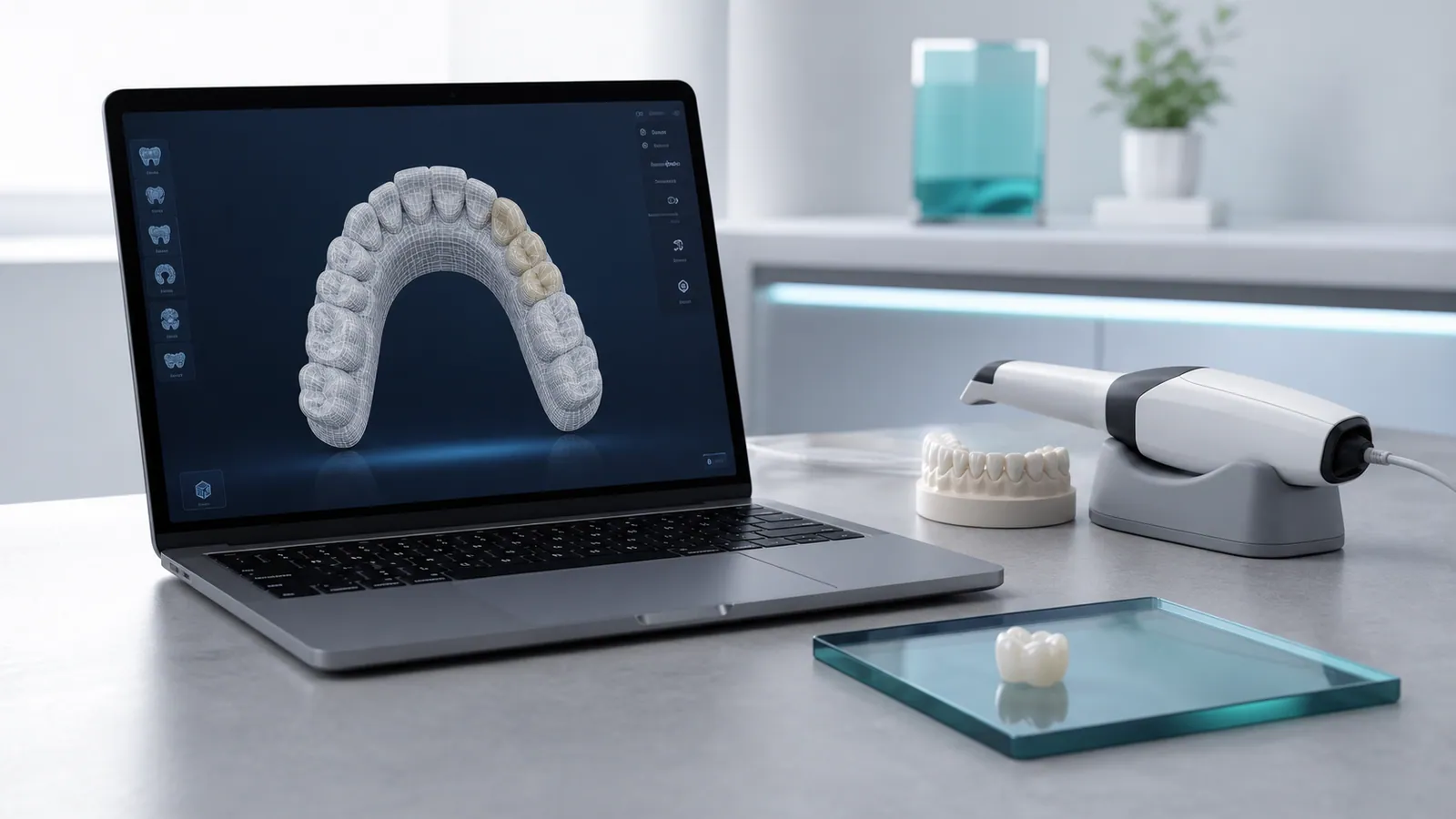
“The bite is high” is one of the most common complaints a laboratory receives, and one of the most often misattributed. The design may be correct against the records it was given and the restoration may still sit high in the mouth, because the record that defined the bite did not match the patient. Understanding what a bite record conveys — and how a laboratory uses it — makes the source of the problem much easier to locate.
What a bite record actually is
A bite record is a physical or digital statement of one thing: the relationship between the upper and lower arches at a defined moment. It does not record how the patient moves, how they load, or where they habitually hold their jaw. It records a single position.
That narrowness is the root of most bite problems, because occlusion in function is not a single position. It is a set of relationships across movement. A record that captures the wrong position — or captures the right position badly — will produce a restoration that is correct against the record and wrong against the patient.
How the laboratory uses it
For a conventional (analogue) case, the record is used to mount the upper and lower models in the correct relationship on an articulator — a mechanical device that mimics the jaw’s movement to a chosen degree of accuracy:
| Articulator type | What it reproduces | Typical use |
|---|---|---|
| Simple hinge | Opening and closing around a single axis | Single units with no significant guidance |
| Semi-adjustable | Hinge plus adjustable condylar guidance and intercondylar distance | Most crown, bridge and multi-unit work |
| Fully adjustable | Individual patient-specific movement parameters | Complex occlusal reconstruction, full-mouth work |
The articulator is only as good as the record and the facebow transfer that positions the upper model relative to the patient’s skull. A semi-adjustable articulator fed a poor record produces a confident, precise, wrong result — which is worse than an obviously rough one, because the error is invisible until the chair.
For digital cases, the same logic applies in software: the bite registration supplied alongside the scans defines the occlusal relationship the design is built against. A digital workflow does not remove the need for a good record; it removes only the plaster.
Where records most often fail
1. The record captures the wrong position
A patient may close into a habitual, slightly anterior or slightly lateral position that is not their centric relation. If the record is taken in that position without the clinician being aware, the restoration is designed to a position the patient does not return to under load. The result reads as an occlusal error and is actually a recording error.
2. The record is distorted
Silicone or wax records compress, tear or spring. A record that is thin in one area and thick in another translates into a tilted mounting. Warmth during storage or transport can deform a wax record below the point of usefulness.
3. The record and the scan disagree
In digital cases, the bite registration and the scanned arches are separate datasets. If they were captured at different times, or if the patient moved between captures, the software is asked to reconcile two statements that do not match. The mismatch appears as a design that seats correctly and occludes incorrectly.
4. The mounting is verified against the wrong reference
A facebow transfer positions the upper model relative to the patient’s anatomical reference. If the transfer is omitted on a case that needed it, or taken loosely, the mounting is rotated relative to the patient and every subsequent occlusal relationship carries that rotation.
5. Edentulous and partially edentulous cases
Where there are no posterior teeth to stop the arches closing together, the record becomes harder to take and easier to distort. This is the situation where a poorly taken record causes the largest error, because there is no natural reference to correct against.
Capturing a record that survives the journey
The practical measures that reduce record failure:
- Take the record in the intended position, deliberately. Where centric relation is the target, use an established technique to guide the patient there rather than accepting the first closure.
- Verify the record before sending it. Seat the record and look at the occlusal contact pattern it produces. A record that seats inconsistently or looks uneven is better retaken than sent.
- Use a material suited to the case. For most single units a rigid, dimensionally stable material is more forgiving than wax. Where a jig or anterior stop is needed to stabilise the closure, use one.
- Include a facebow transfer where the case needs it. For anything beyond a simple single unit, the transfer is what makes the mounting meaningful.
- Package the record so it cannot deform. A record that survives the impression stage but is crushed in transit is still a failed record. Rigid support in the packaging matters more for records than for most other items.
- For digital cases, capture arches and bite in one session. If they cannot be captured together, note it so the laboratory knows the datasets are independent.
What to tell the laboratory when something looks wrong
If a restoration comes back and the occlusion is not what you expected, the most useful thing you can send is not the restoration alone but the record, the photos of the contact pattern in the mouth, and a description of where the contact is heavy or absent. With those, the laboratory can check whether the design matched the record and, if it did, whether the record matched the patient. That question is the one that actually determines whose issue it is — and it is the same review logic described in the remake and issue review policy.
A note on digital workflows
Digital impression systems reduce several conventional error sources: no impression distortion, no model pouring, no plaster expansion. They do not remove the occlusal record problem, and in some ways they make it more visible, because a digital design that seats perfectly on the scanned surface can still occlude incorrectly if the bite registration was taken in the wrong position. Speed of capture is not the same as accuracy of relationship.
Related reading
- Digital vs traditional dental impressions — what changes and what does not when the workflow goes digital.
- Tooth reduction guide — the other half of the occlusal-space equation.
- Common implant restoration errors — occlusal and connection issues specific to implant units.
- How to reduce dental remakes — the upstream causes, ranked by how often they occur.