
Product guidance
Types of Dental Veneers: Feldspathic, E.max and Ultra-Thin Options
Veneer type decides prep, thickness and esthetic ceiling. This guide compares feldspathic, E.max and ultra-thin options and the case data each one needs.
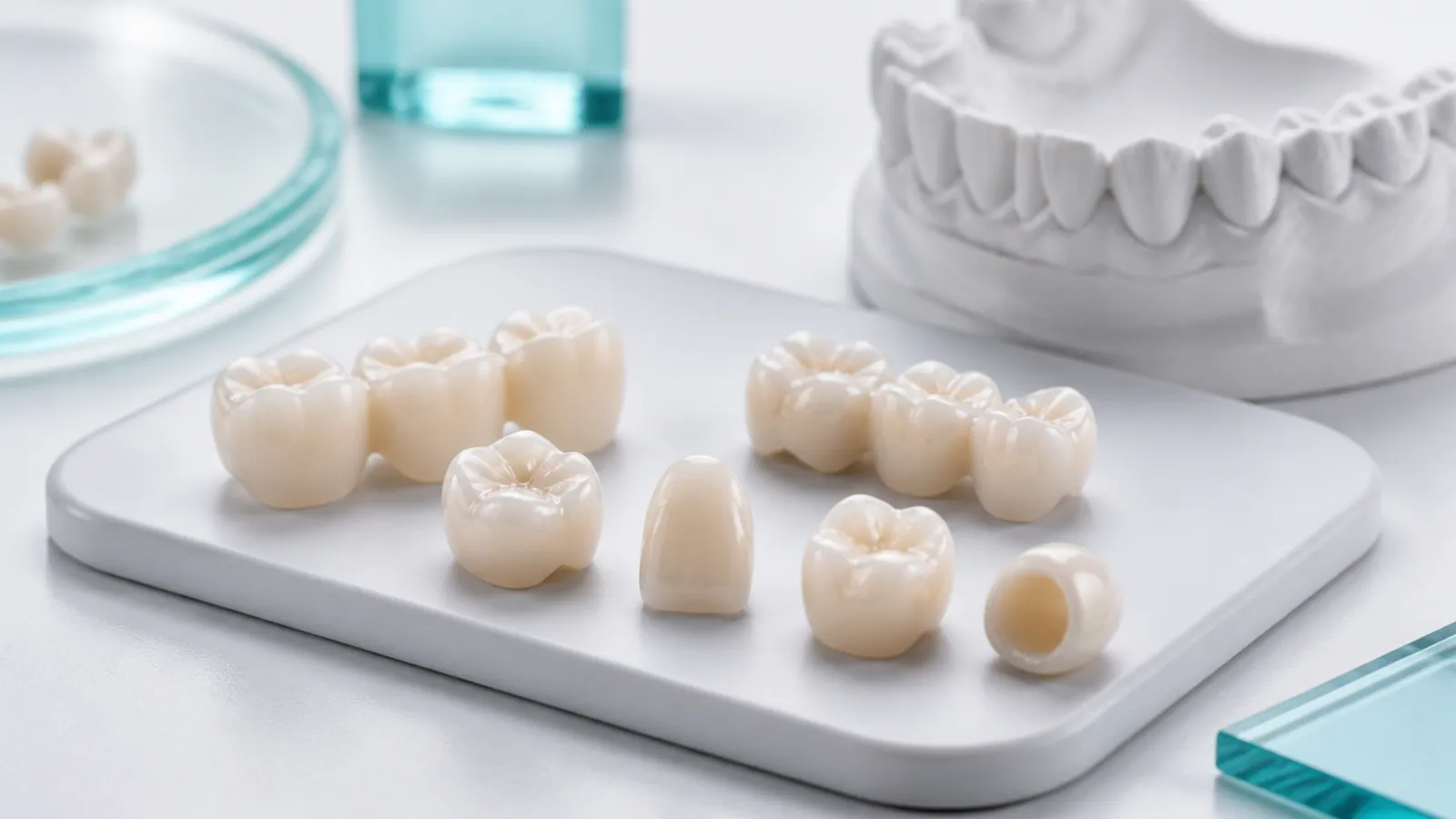
Selecting among the types of dental veneers is less about picking a material and more about matching thickness, preparation and esthetic goals to the tooth in front of you. The three families most often specified — feldspathic porcelain, lithium disilicate and ultra-thin options — solve different problems, and the wrong choice usually shows up as either too much reduction or not enough masking.
This guide compares the main veneer types on thickness, preparation and case selection, and links to the broader dental veneers product scope and the ultra-thin and minimal-prep detail page.
What separates veneer types
The practical difference between veneer types is how much tooth structure they need and how much they can change the appearance of the tooth. Feldspathic porcelain is built in layers and relies on the underlying tooth for support and color. Lithium disilicate is a pressed or milled glass-ceramic with more strength, which allows thinner walls and a wider case range. Ultra-thin veneers push thickness down further and, as a result, narrow the list of cases they suit.
The choice is driven by enamel quality, the starting color, and how much change the patient expects. A veneer that needs to mask a dark tooth is a different specification from one that only reshapes an already light one.
Feldspathic porcelain
Feldspathic veneers are constructed by building and firing porcelain directly, often on a refractory model, which gives the technician detailed control over surface character and translucency. They are valued for their optical behavior — the way light passes through and the depth of color they can show.
Their limitation is strength and dependence on the underlying tooth. Feldspathic veneers need a sound, well-etched enamel bond and a conservative preparation, and they are less suited to heavy occlusal loads or to cases with significant color correction. They reward careful bonding and a technician comfortable with layered characterization.
Lithium disilicate
Lithium disilicate, often supplied as a milled or pressed block, brings more flexural strength than feldspathic porcelain while still reading naturally in the esthetic zone. That strength widens the case range: it tolerates slightly thinner preparations than many expect and handles anterior units and some premolar situations well.
From a lab standpoint, E.max crowns and veneers made from lithium disilicate allow both pressing and milling routes, with staining and glazing for incisal character. The trade is that very high-strength situations still favor a different material, and the esthetic ceiling, while high, is set by the block’s optical properties rather than free-hand layering.
Ultra-thin veneers
Ultra-thin veneers are defined by minimal thickness, frequently in the range where no or almost no tooth reduction is planned. They are most usefully seen as a conservative option for patients whose teeth are already close to the target shade and shape. Because there is little material, they can only do a little, and that is the point.
The detail page on ultra-thin and minimal-prep veneers covers thickness limits and contraindications. In short, they widen the conservative end of the spectrum but demand more from the underlying enamel and the bonding step.
Preparation requirements by type
Feldspathic veneers usually need a conservative facial reduction with a defined margin and intact enamel for bonding. Lithium disilicate can be prepared similarly but tolerates a slightly shallower reduction in many cases, with the connector and incisal dimensions confirmed for the route chosen. Ultra-thin veneers aim for no preparation or a feathered edge, which makes the existing enamel surface and shade the dominant variables.
Regardless of type, the margin should be readable and the reduction even. A preparation that varies in depth produces a veneer that varies in color, because the porcelain thickness is what carries the shade.
Esthetic potential
Feldspathic porcelain gives the technician detailed control for custom characterization because it is built by hand in layers. Lithium disilicate reaches a strong, natural result through staining and glaze, with the block providing consistent optical behavior. Ultra-thin veneers deliver limited change, which is appropriate when the goal is refinement rather than transformation.
For cases needing significant color correction, none of these should be expected to mask a very dark substrate without added thickness or, in some situations, a different restoration type. The zirconia vs E.max comparison is useful when strength or masking dominates the decision.
Case selection limits
Feldspathic veneers suit sound enamel, light to moderate shade change, and patients with good bonding conditions. Lithium disilicate extends into cases needing more strength or a bit more correction. Ultra-thin veneers suit already-favorable teeth where the change is small.
Bruxism, poor enamel, heavy occlusal load, and significant discolorations push the case toward more traditional preparations or alternative restorations. The lab’s role is to confirm the preparation supports the veneer type you specify, not to guess at a different plan.
What the lab needs with the case
Provide a clear prescription stating veneer type, tooth numbers, and target shade, plus a stump shade and a neutral-lighting photograph of the target teeth. Include opposing arch contacts and any design preferences such as incisal character or surface texture. A clean margin photo helps the lab confirm the preparation is what the prescription assumes.
If the records suggest the specified type will not deliver the expected result, expect a question before production rather than a silent substitution. That check protects the case.
Next step
To plan a veneer case, send a case with a complete prescription, shade reference and margin photographs so the lab can confirm the veneer type fits the preparation. For conservative situations, review the ultra-thin and minimal-prep veneers guidance first, and for strength questions see the E.max product page.