
Logistics
How Dental Restorations Are Packed and Shipped Internationally
A restoration that is perfect at the bench can arrive chipped, distorted or delayed. This is how a case is packed for international transit and what travels with it.
Published October 5, 2026
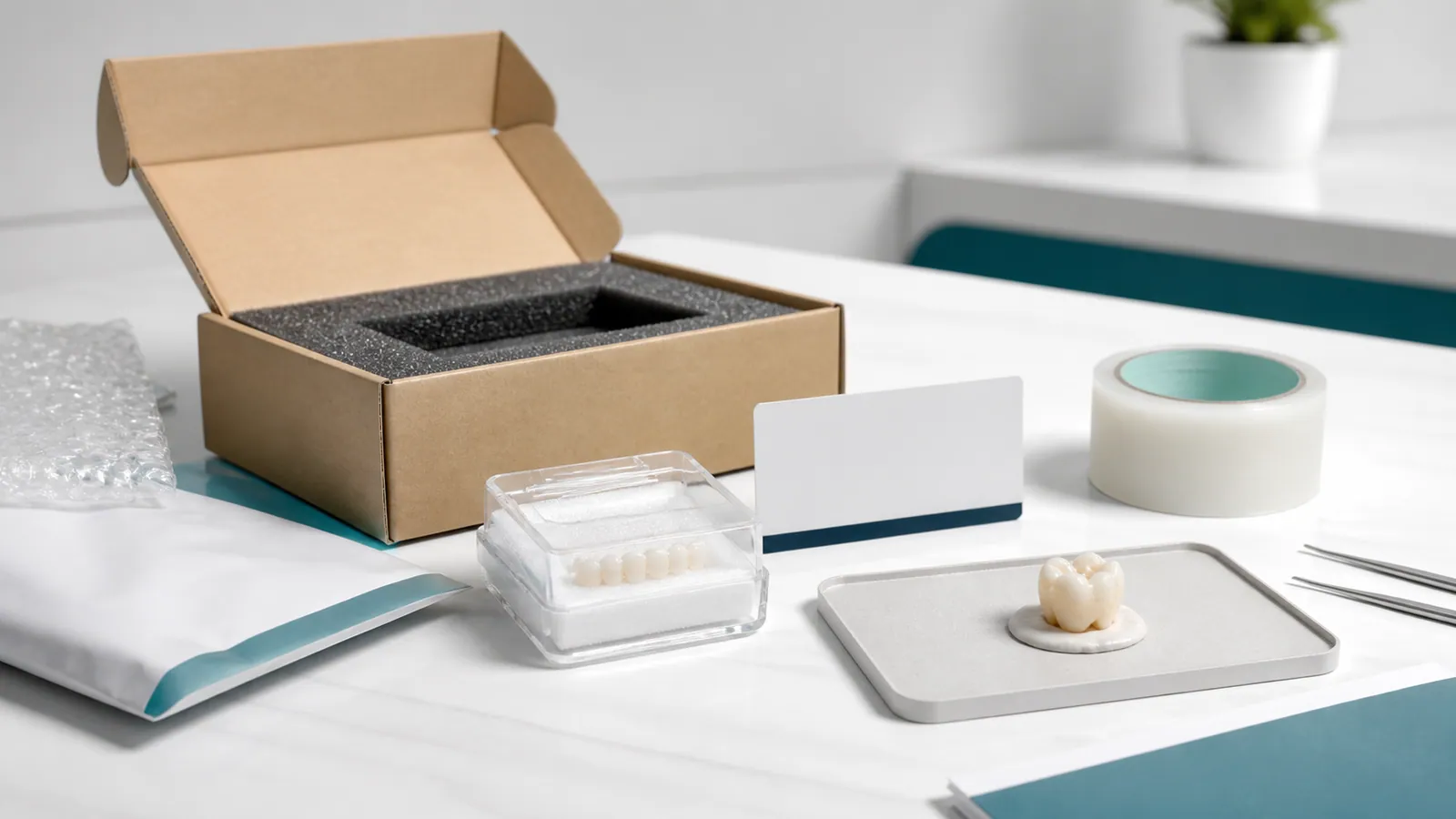
Quality control ends at the bench; the case still has to survive a courier network, a customs process and a handover before it reaches the chair. A restoration that measured correctly at final inspection can arrive chipped, distorted or delayed. This article covers how a case is protected for international transit, what documentation travels with it and where the predictable risks are.
Why transit is a real risk, not a formality
Three physical facts make dental restorations awkward to ship:
- They are small, light and fragile in specific ways. A zirconia unit is strong in compression and brittle under point impact. A thin veneer is fragile in flexion. A denture is dimensionally stable but can crack at a thin flange.
- They must not move inside the package. Free movement inside a box means the restorations collide with each other and with the walls. Most transit damage is not a crushed box; it is an intact box containing loose parts.
- Moisture and temperature matter. Some materials and, more importantly, some bite records and impression materials are sensitive to heat and humidity. A record that deforms in transit has the same effect as a poor record.
How a case is packed
Individual protection first
Each restoration is protected individually before anything else happens. The unit is placed in a protective container or wrap that prevents contact with other units, then secured so it cannot move. The point is that no two hard surfaces touch, and no unit can shift.
Immobilisation, not just padding
Padding alone is not enough. A box filled with soft material still allows movement. The interior is filled so that the contents are held in position — the restorations, any models and any records cannot move relative to the box no matter how the parcel is handled or which way up it travels.
Rigid outer packaging
A rigid outer container resists stacking loads and prevents the parcel from being crushed when it is at the bottom of a sorting pile. The outer box is sized to the contents so there is no large void to fill, which is what usually causes internal movement.
Models and records supported separately
Where a case includes a physical model or bite record, these are supported so they cannot flex or compress. A record that is allowed to bend in transit arrives as a different record.
Labelling and orientation
The package is labelled so the contents are identifiable against the case reference, and any orientation requirement is marked. Restorations are shipped with their case reference rather than a patient identifier — the same privacy discipline that applies to incoming files.
What travels with the case
| Item | Why it matters |
|---|---|
| Case reference | Links everything back to the correct case without naming a patient |
| Delivery note listing what was checked | Records the final inspection outcome against the case |
| Material or lot documentation, on request | Required for traceability and for some destination markets |
| Shade and specification summary | Confirms what was produced against what was prescribed |
| Courier and tracking details | Sent separately so both sides can follow the shipment |
The delivery note is the document that makes an issue review possible later, because it records what was inspected and when.
How the courier and customs layer works
International delivery is a separate process from production, and it adds its own variables:
- Route availability. Courier services do not reach every destination at the same speed, and service levels vary by country and by city.
- Customs clearance. Cross-border shipments may be held for documentation or duty assessment. This time is outside the laboratory’s control and outside production time.
- Duty and tax. Responsibility for import duty and tax depends on the agreed terms for the specific customer relationship and on the destination market’s rules. It is confirmed per relationship rather than assumed.
- Public holidays and disruptions. Holidays in either the origin or destination country, and weather or routing disruptions, both affect delivery.
- Declared value and description. The shipment must be described accurately for customs. This is a compliance matter, not a choice.
Because of these variables, production time and delivery time are quoted separately, and delivery is confirmed per case rather than promised as a fixed window. The estimated production ranges are on the Turnaround and Shipping page.
What can go wrong, and what to do
| Symptom | Likely cause | Action |
|---|---|---|
| Restoration chipped on arrival | Point impact during transit, or movement inside the package | Photograph the packaging as received and the damage, then follow the issue review process |
| Contact or occlusion off after mounting | Model or record deformed in transit, or a seating error | Send photos of the contact pattern; the record can be re-examined |
| Shade appears different from expectation | Nothing structural — often viewing conditions differ from the lab’s | Compare under consistent lighting with a shade reference before raising it |
| Shipment held at customs | Documentation or duty assessment | Courier will usually contact the recipient; resolve directly with the courier |
| Package arrived intact but appears empty of a small item | A unit can settle into packaging filling | Inspect the filling material thoroughly before concluding anything is missing |
For any damage or loss in transit, the review begins with the courier claim, but the case-level response is handled through the same remake and issue review policy as any other reported issue.
What a laboratory customer can do
- Confirm the delivery address and any local requirements before the first shipment, including any documentation the destination market requires.
- Inspect the package on arrival, before opening it fully. Photograph the outer packaging if there is any sign of damage.
- Keep the packaging until the case is verified, in case a courier claim is needed.
- Report a transit problem promptly. Courier claim windows are time-limited, so a delay in reporting can close options that were open.
Related reading
- Turnaround and shipping — estimated production ranges and what changes the schedule.
- Dental lab turnaround and shipping — the same subject written for a laboratory audience.
- Remake and issue review policy — the process when a delivered restoration is questioned.
- Material traceability in a dental lab — the documentation that travels behind each case.